Labor Day Notice: Our pharmacy will be closed Monday, September 7.



Labor Day Notice: Our pharmacy will be closed Monday, September 7.





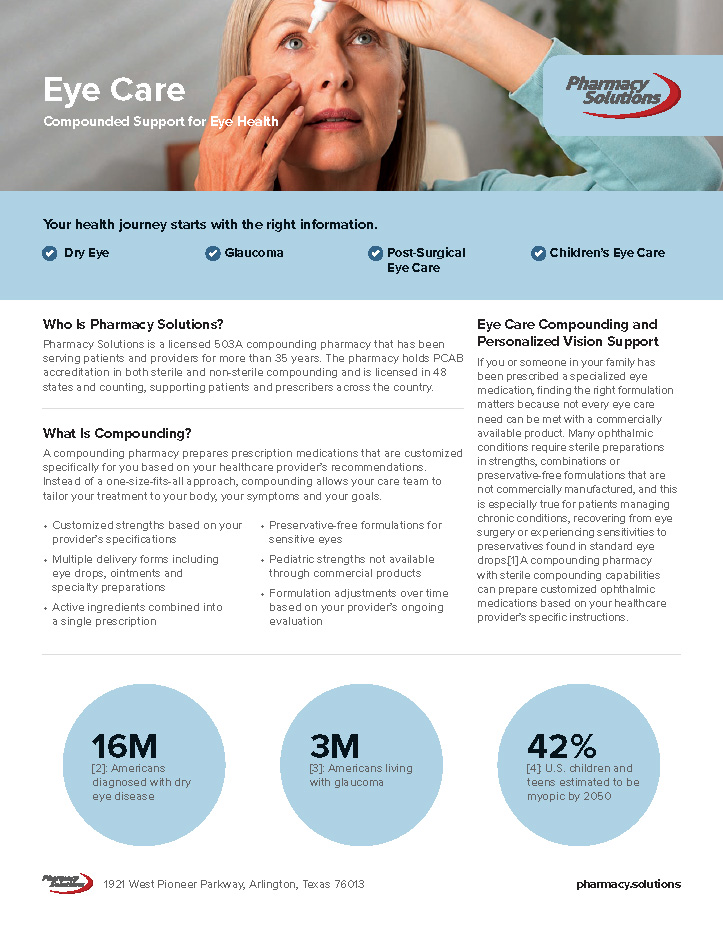
Children’s eyes are still developing, and their needs are often different from those of adult patients. Standard commercial ophthalmic medications may not always offer the age-appropriate strengths, preservative profiles or dosing flexibility that growing eyes need. Pediatric eye care providers sometimes prescribe compounded formulations when a personalized approach is appropriate. The most common pediatric application is low-dose atropine for myopia management, typically prepared in customizable strengths between 0.01% and 0.1%, which has been studied for its potential role in slowing the progression of nearsightedness in children. Compounded atropine may also be used as part of amblyopia therapy in certain cases, either as an alternative to patching or in combination with it. For children who are particularly sensitive to preservatives in commercial drops, preservative-free steroid and specialty formulations can be prepared based on the provider’s prescription. Pharmacy Solutions prepares pediatric ophthalmic formulations in a USP <797> and USP <800> compliant sterile cleanroom. All pediatric eye care is led by a pediatric optometrist or ophthalmologist who determines what is appropriate for each child. For lifestyle support, research has suggested that outdoor time may play a protective role in myopia progression, along with regular breaks from near work and screen time. Any supplement use for a child should be discussed with the pediatrician or eye care provider first.

When my son’s eye doctor talked about low-dose atropine for his myopia, I had a lot of questions. Between the doctor’s office and the pharmacy walking me through each step, I felt informed and supported throughout the process. It made a real difference in how comfortable I felt about the plan.
Low-dose atropine is a compounded formulation, typically prepared in concentrations between 0.01% and 0.1%, that has been studied for its potential role in slowing the progression of myopia, or nearsightedness, in children.[2][3] It is prescribed and monitored by a pediatric optometrist or ophthalmologist. Because progressive myopia is associated with greater long-term eye health risks, slowing its progression during childhood may help support long-term vision.[5]
Compounded atropine for pediatric use is prepared only after a licensed provider writes a prescription for a specific child. At the low concentrations typically used for myopia management, atropine has been extensively studied in pediatric populations. Any safety considerations or potential side effects should be discussed directly with your child’s eye care provider, who can evaluate whether the medication is appropriate and monitor your child’s response over time.
Amblyopia, sometimes called lazy eye, is typically managed by a pediatric eye care provider. Standard approaches often begin with patching the stronger eye to encourage use of the weaker eye. In some cases, atropine drops may be used as an alternative or in combination with patching when the provider determines it is appropriate.[4] Your child’s eye care provider will explain what fits your child’s specific situation.
Yes. All compounded medications are prepared only after a licensed provider writes a prescription for a specific patient. For children, prescriptions typically come from a pediatric optometrist, pediatric ophthalmologist or a general eye care provider experienced in pediatric care. If you do not currently have a pediatric eye care provider, our team can help connect you with one.
They can be, particularly for children who are sensitive to preservatives in commercial drops or who need long-term therapy. Preservative-free formulations can help reduce surface irritation, which supports comfort and adherence. Your child’s eye care provider can determine whether preservative-free is appropriate for your child’s situation.
Your child’s eye care provider and the pharmacy team can offer specific tips, but general approaches include having the child lie down with eyes closed, placing the drop in the inner corner and letting it flow in when the child opens the eye, or administering drops when a child is relaxed or drowsy. Consistency matters for pediatric eye care, so if you are struggling with administration, reach out to your provider for guidance rather than skipping doses.
Research supports outdoor time as potentially protective against myopia progression, regular breaks from near work and screen time, proper lighting for reading, adequate sleep and protective eyewear during sports.[5] For any supplement or vitamin questions, check with your child’s pediatrician or eye care provider before starting anything new.
If you do not currently have a pediatric eye care provider, Pharmacy Solutions may be able to help connect you with practitioners in your area. Pediatric optometrists and pediatric ophthalmologists are typically the providers who manage children’s eye conditions.
[1] American Academy of Ophthalmology. Pediatric Eye Evaluations Preferred Practice Pattern. https://www.aao.org/preferred-practice-pattern/pediatric-eye-evaluations-ppp
[2] Yam JC, et al. Low-Concentration Atropine for Myopia Progression (LAMP) Study. Ophthalmology. 2019. https://pubmed.ncbi.nlm.nih.gov/30514630/
[3] Chia A, et al. Atropine for the treatment of childhood myopia. Ophthalmology. 2012. https://pubmed.ncbi.nlm.nih.gov/22204865/
[4] Pediatric Eye Disease Investigator Group. Amblyopia treatment studies. https://public.jaeb.org/pedig
[5] Walline JJ, et al. Interventions to slow progression of myopia in children. Cochrane Database Syst Rev. 2020. https://pubmed.ncbi.nlm.nih.gov/31930781/
[6] American Association for Pediatric Ophthalmology and Strabismus. Pediatric eye conditions. https://aapos.org/
Tell us a little about what you are looking for and we will take it from there. Whether you have a prescription ready, questions about a therapy your provider mentioned, or just need help figuring out your next step, our team is here and ready to help.
"*" indicates required fields

To submit your order, click the “PRINT/SAVE” button located under this pop-up.

You can save the PDF to your computer to fax at a later date or print it now to fax immediately.

Fax your order form to 817-860-6083 for processing.

Get detailed information, research, and deeper product context. Toggle on to see more educational content.
Keep things brief and see related products faster. Toggle on to focus on products.

New to Pharmacy Solutions? Register now