Labor Day Notice: Our pharmacy will be closed Monday, September 7.





Labor Day Notice: Our pharmacy will be closed Monday, September 7.





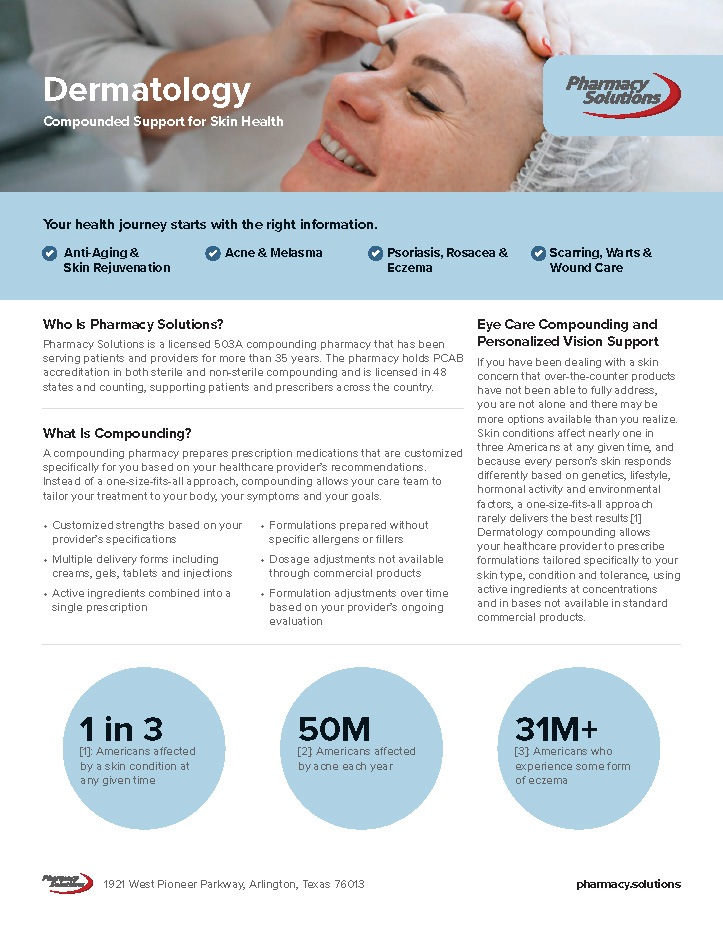
Melasma is a common pigmentation disorder that causes brown or gray-brown patches on the skin, most often on the face. It is significantly more common in women and is closely tied to hormonal changes including pregnancy, oral contraceptive use and hormone therapy, as well as UV exposure. Because melanin production involves multiple biochemical pathways, melasma is typically most effectively managed with a multi-ingredient approach that addresses several of those pathways simultaneously. Compounded melasma formulations allow healthcare providers to prescribe specific combinations of active ingredients at concentrations suited to each patient’s skin tone, pigmentation severity and history. Active ingredients commonly incorporated into compounded melasma preparations include hydroquinone for inhibiting melanin production, tretinoin for supporting cell turnover and enhancing ingredient penetration, kojic acid and azelaic acid for complementary melanin-inhibiting effects, niacinamide for tone and barrier support, tranexamic acid for its studied role in reducing pigmentation and corticosteroids at low concentrations when appropriate. Ascorbic acid and other antioxidants may also be incorporated. Consistent broad-spectrum sun protection is an essential part of any melasma management plan regardless of other approaches being used. Pharmacy Solutions is a PCAB-accredited 503A compounding pharmacy that works with dermatologists and other providers nationwide to prepare individualized melasma formulations. The RX Skin Solutions line and EltaMD sunscreens are also available without a prescription through the Pharmacy Solutions shop.


I had been struggling with my skin for a long time and felt like nothing off the shelf was working. Once my dermatologist connected me with Pharmacy Solutions, I finally had a plan that felt like it was made for me. The pharmacy team answered all of my questions and made the process simple.
I had been noticing real changes in my skin and honestly had no idea what to do about it. My provider prescribed a customized formulation through Pharmacy Solutions and took the time to explain what each ingredient actually does. It made the whole process feel approachable rather than overwhelming.
I had tried so many things over the years and nothing seemed to work for long. My dermatologist finally prescribed a compounded formula through Pharmacy Solutions that was actually built around my skin. The difference was noticeable and, for the first time, I felt like someone had actually looked at my situation rather than just handing me something off the shelf.
Melasma is a common pigmentation disorder that causes brown, gray-brown or grayish patches to develop on the skin, most often on the face. It is significantly more common in women than in men, with approximately 90% of cases occurring in women. It is particularly prevalent in individuals with naturally darker skin tones and in those who have experienced significant hormonal changes, including pregnancy, the use of oral contraceptives or hormone therapy. UV exposure is a major contributing trigger.
Melasma results from overactivity of melanocytes, the skin cells responsible for producing pigment. This overactivity can be triggered or worsened by UV exposure, hormonal changes, heat, certain medications and genetic predisposition. Because multiple triggers are often involved, management typically requires a combination approach that addresses several pathways simultaneously rather than relying on a single ingredient.
Yes. Compounded melasma formulations typically contain prescription-strength ingredients such as hydroquinone, tretinoin or corticosteroids, which require a valid prescription from a licensed healthcare provider. Some over-the-counter options containing lower concentrations of azelaic acid, niacinamide or kojic acid are available without a prescription, though a healthcare provider can help determine the most appropriate approach for your skin.
Compounded melasma formulations may include a range of active ingredients depending on the provider’s assessment. Common examples include hydroquinone for inhibiting melanin production, tretinoin for supporting cell turnover and enhancing ingredient penetration, kojic acid and azelaic acid for additional melanin-inhibiting effects, niacinamide for tone and barrier support, tranexamic acid for its studied role in reducing pigmentation, and corticosteroids in select formulations to help manage inflammation. The specific combination and concentration are always determined by the prescribing provider.
Melasma management requires patience and consistency. Most providers recommend a minimum of eight to twelve weeks of consistent use before evaluating the response to a new formulation. Results vary depending on the severity of the pigmentation, the ingredients prescribed, the patient’s sun protection habits and individual skin response. Your healthcare provider will monitor progress and adjust the formulation as needed.
Melasma is a chronic condition for many people, and recurrence is common, particularly with ongoing sun exposure or hormonal changes. Maintaining consistent sun protection and following up with your healthcare provider are important parts of long-term management. Compounded formulations can be adjusted over time to address changes in pigmentation or skin response.
Yes. Pharmacy Solutions carries pharmaceutical-grade skin care products that may support a broader skin tone management routine. The RX Skin Solutions line and EltaMD products are available through the Pharmacy Solutions shop without a prescription. Daily broad-spectrum sun protection is one of the most important steps in managing melasma, and EltaMD sunscreens are formulated to be well tolerated by sensitive skin.
[1] American Academy of Dermatology Association. Melasma: Overview. https://www.aad.org/public/diseases/a-z/melasma-overview
[2] Sheth VM, Pandya AG. Melasma: a comprehensive update, part I. J Am Acad Dermatol. 2011;65(4):689-697. https://pubmed.ncbi.nlm.nih.gov/21920241/
[3] Mukherjee S, et al. Retinoids in the treatment of skin aging. Clin Interv Aging. 2006;1(4):327-348. https://pmc.ncbi.nlm.nih.gov/articles/PMC2699641/
[4] Pullar JM, Carr AC, Vissers MCM. The roles of vitamin C in skin health. Nutrients. 2017;9(8):866. https://pmc.ncbi.nlm.nih.gov/articles/PMC5579659/
[5] Pharmacy Compounding Accreditation Board (PCAB). Accreditation Commission for Health Care. https://www.achc.org/pcab/
Tell us a little about what you are looking for and we will take it from there. Whether you have a prescription ready, questions about a therapy your provider mentioned, or just need help figuring out your next step, our team is here and ready to help.
"*" indicates required fields

To submit your order, click the “PRINT/SAVE” button located under this pop-up.

You can save the PDF to your computer to fax at a later date or print it now to fax immediately.

Fax your order form to 817-860-6083 for processing.

Get detailed information, research, and deeper product context. Toggle on to see more educational content.
Keep things brief and see related products faster. Toggle on to focus on products.

New to Pharmacy Solutions? Register now